
The Nigerian real estate sector is facing a dilemma that is getting tough to overlook.
There is constant growth in property prices and rental rates, although not in the earnings of the potential tenants of these properties. There is also a sharp rise in construction costs, making it more difficult for developers to provide affordable housing options without hiking their prices further up.
This brings up a tough query about property prices and whether their prices will keep on growing even when fewer people can afford them.
According to a recent report, the Nigerian rent to income ratio currently stands at 70% while according to the BusinessDay news publication, rental rates in major cities of Nigeria have experienced sharp growth, even recording a 200% increase sometimes.
These figures do not mean that Nigeria is experiencing a looming property price crash all over the nation.
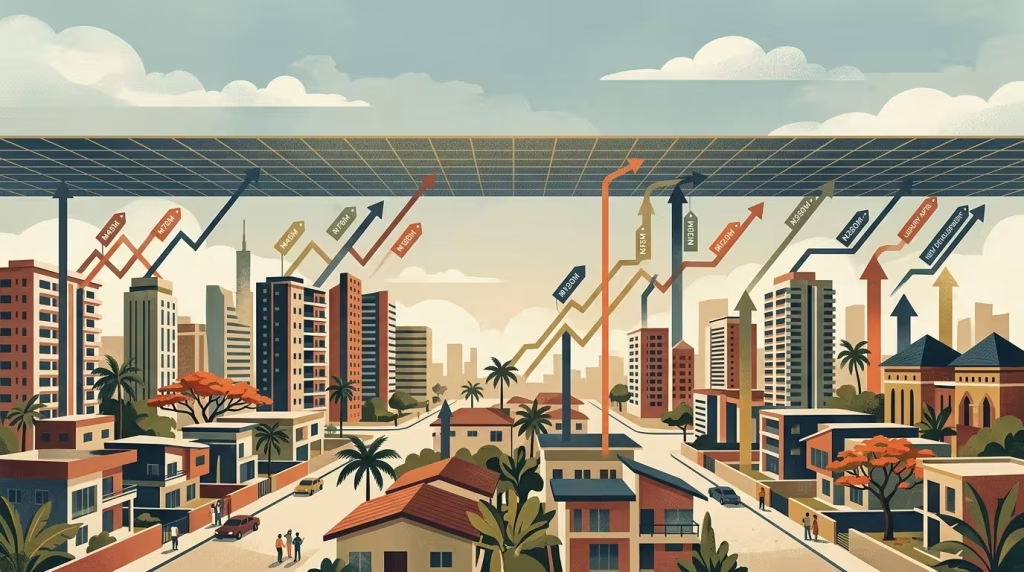
They show a troubled market. And this difference is important.
The correction does not come in terms of an outright drop in property prices. It can come through lengthy sales cycles, more negotiations, rising vacancy rates, and slow rent increases, among other means.
The Affordability Problem Is Getting Harder to Ignore
Let us consider the market situation from the standpoint of a typical Nigerian family.
A family has more money in its pockets than it had a few years ago. But prices for food, travel, tuition fees, and other costs have risen as well. And then, the landlord hikes the yearly rent payment by a couple of hundred thousand naira.
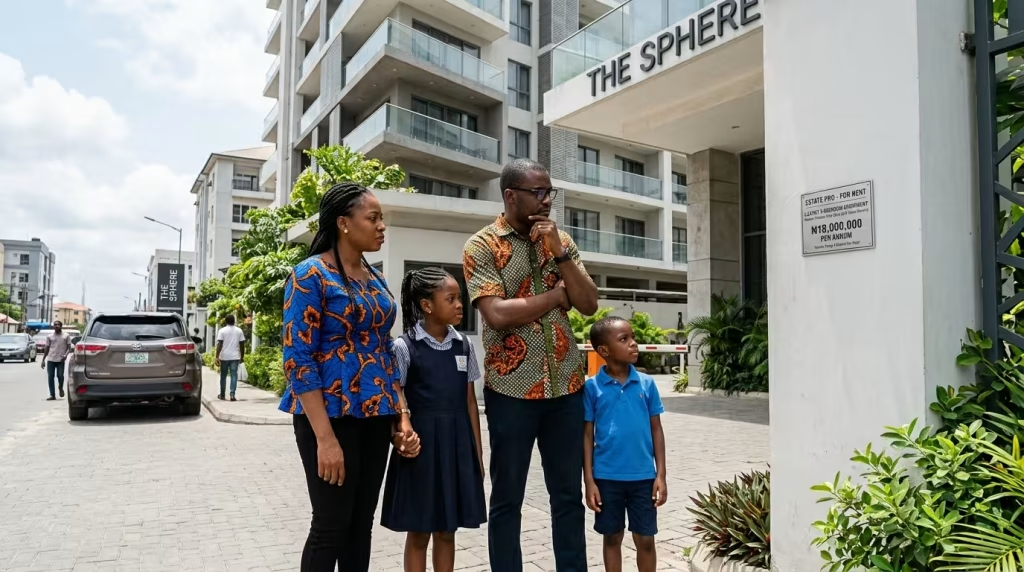
Now the family has only one way out: move somewhere farther, live in a smaller house, pay a significantly bigger portion of its income for accommodation, or stop renting.
This situation already appears in existing statistics.
According to BusinessDay, published in March, many Nigerian tenants now spend over 60% of their income on rent payments, and according to other estimates, up to 70%. And 30% is the widely used affordability criterion.
Another of their article put the national income-to-rent ratio at 70%, and related this problem to rising rent prices, fast urbanization, the housing shortage, and an unbalanced market focused on upscale housing.
Here we have a paradoxical situation.
Nigeria doesn’t lack people who need housing. Nigeria has millions of people who need housing but find it increasingly difficult to pay for houses.
The difference might affect future developments.
Rents Have Risen Faster Than Many Households Can Absorb
Rent increases exacerbate the problem even further.
According to BusinessDay, rental costs in Nigeria have increased by 200-300% during the period from 2020 to 2025. It cites an example of Lagos State where properties that were leased at hundreds of thousands of naira before have increased to several million naira yearly.
Rising rents do not always give the landlord an upper hand in charging rents.
There will be a certain point when the potential tenants will start decreasing.
A landlord can increase the asking rent from ₦2 million to ₦3 million. However, if there is a considerable reduction in the number of people able to pay ₦3 million, it will take him more time to find a tenant.
It will change the market.
While the advertised price remains high, the price at which the transaction takes place becomes increasingly negotiable.
A landlord might choose to give a reduction in the price, accept payments in installments, reduce expenses connected with the agencies, or rent out the property for less rent than to leave it empty.
This difference between the asking price and the effective price is critically important in understanding the property market in Nigeria.
There is no need for a market to crash before it corrects itself.
Correction can begin even when sellers and landlords lose their power of pricing.
Construction Costs Are Creating Another Problem
But there is pressure on the supply side, too.
Developers cannot respond to the increase in demand for more affordable homes if their construction costs continue to be on the rise.
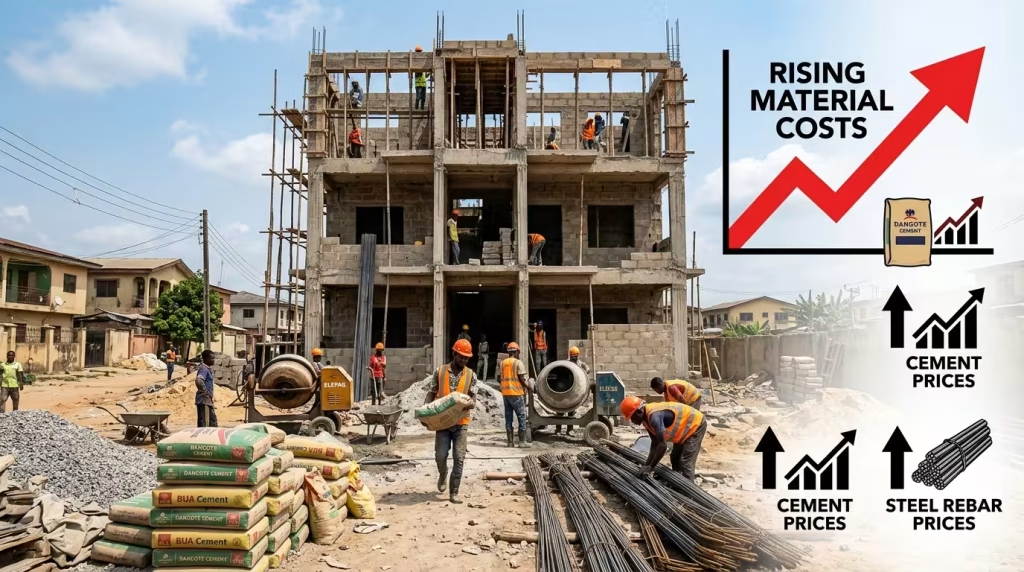
The price of a 50kg bag of cement increased from around ₦7,500 at the end of 2025 to between ₦12,00 and ₦15,000 in various parts of the country in 2026.
The cement is but one component of the construction costs. There is still the cost of reinforcement bars, roofing materials, tiles, labor, land, infrastructure, finances, and other components.
Faced with increasing costs, developers face a hard decision to make.
It could mean building less-costly homes. It could mean choosing less costly areas in which to build or delaying construction.
It could also mean passing on the higher costs to homebuyers and tenants.
The latter presents difficulty because prices have already reached their affordability peak.
This may be more critical than just the property price.
Is Nigeria Actually Facing a Property Bubble?
Now is the time for us to take a pause.
It is easy to refer to every rapidly increasing real estate market as a bubble.
The definition of a bubble involves prices exceeding fundamental justifications, typically coupled with the expectation of perpetual price increases. The minute this anticipation stops, demand drops off.
There are some elements that make Nigeria look like the same risk.
Real estate prices have increased rapidly in many areas. The cost of construction has skyrocketed. Affordability is becoming worse. There are still some investors who see land and property as an asset whose value can never go down.
However, there are also many other factors in Nigeria.
There are reports that there is a housing deficit in Nigeria of about 14.9 million housing units. Other estimates show shortages in major cities.
This implies that just looking at high prices does not mean that there is an excess supply of houses in Nigeria.
The important question is: Is there an excess supply of houses that people can afford?
The Market Could Correct Without Collapsing
This is possibly the most important factor to consider for any investor watching Nigerian property in 2026.
A market correction does not always mean that there is an immediate drop of prices in properties by 30% or 40%.
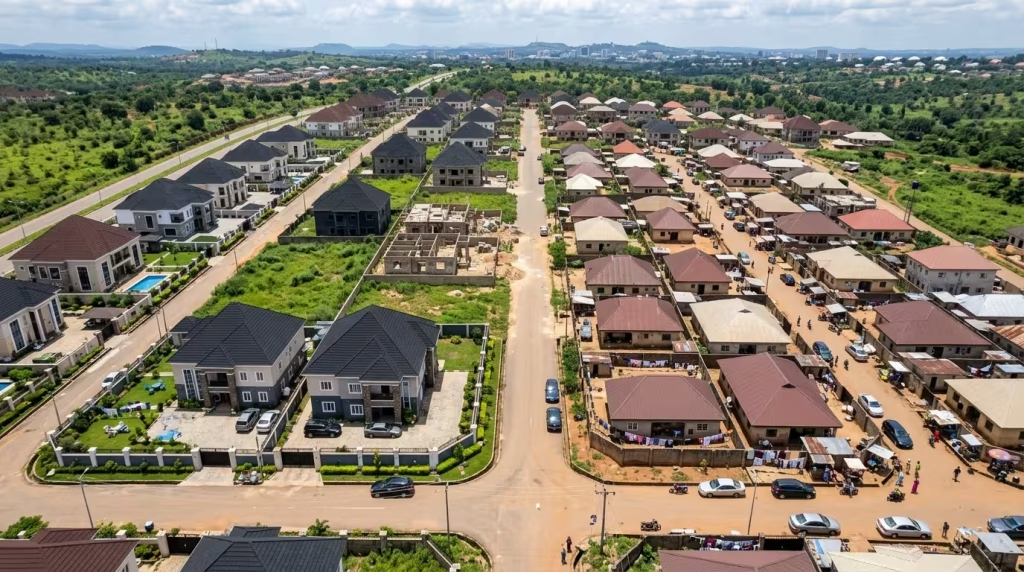
The market can correct itself through different means.
- Luxury properties may take much longer to be sold.
- Bargaining from buyers could become tougher.
- Builders may build smaller houses. So, instead of building three bedrooms, developers build two units of one bedroom.
- Landlords may find themselves unable to raise rents.
- There will be higher vacancy levels in poorly located and overvalued properties.
- Low returns on investment, which cannot cover construction costs, may delay construction.
- Investments may become more discriminating.
- Properties may lose value, but some may increase in value.
The above point is very important because the Nigerian property market is not one homogenous property market.
Lagos Island is not the same as Lagos Mainland. Maitama, Abuja is not the same as Kubwa. An upscale serviced apartment is not the same as a small family flat. Land next to a new road is not the same as a piece of poorly located land.
Therefore, should there be a correction, it will not impact all areas in the same way.
What Bismarck Rewane’s Warning Means
Economist Bismarck Rewane has continually raised the issue of asset valuations and corrections that may occur in the Nigerian economy. In his market outlooks, he has discussed the dangers of high valuations because of household pressures and economic changes.
The key take-home point for real estate investors need not involve forecasting a collapse.
The key takeaway point is this:
When affordability drops, investors cannot assume that there will be no end to the increase in value that they have experienced.
A property that increased in value by 50% in the previous two years does not deserve to receive 50% again.
Investors must ask themselves: Who will pay the next buyer’s price?
If the price of paying is dependent solely on another investor paying an even higher price, the investment is riskier.
However, if the property has high rental value, good infrastructure, a clear title, fair pricing, and good population growth, the fundamentals of the investment become very different.
This is the type of distinction investors must learn as we approach the year.
What This Means for Buyers
If you are planning to purchase a house this year, do not let any extreme be your guide.
It is unwise to think that the price of property in Nigeria would always go up. And it is equally unwise to believe that prices will crash soon.
It is wise to analyze the property in question.
Do comparisons between similar properties. See how long it took other similar properties to be sold. Do negotiate rather than paying the asking price straight away. Work out your financing costs. Analyze the title and stage of development of the property. Most importantly, see that the property suits your budget and plans.
If correction happens, those who are financially strong will be in an advantageous position.
If the prices keep climbing, those who have been waiting endlessly might end up paying higher prices later.
The idea here should not be to find out the exact bottom of the market. The idea should be not to pay too much for a property which is not worth it.
What This Means for Developers
For developers, there is an even more complex equation.
Development costs are high, but families cannot afford unlimited increases in costs. This means that developers must focus more on the effective demand for property.
A high-end property can underperform if its asking price exceeds what the market will bear. The most potential may be in smaller homes and affordable homes in the right place.
There are other issues that the developer should also consider besides the demand. There are millions of Nigerians who need housing. However, “millions need houses” does not automatically guarantee that all of them will have buyers or tenants.
The location of a property is important. The unit size is important. Price is important. Structure of payment is important.
And increasingly, affordability is more important than aspiration.
The developer who knows this may have more chances of surviving a market correction than the developer who hopes for a continuous increase in property prices to save him/her.
What This Means for Property Investors
The present-day market conditions should lead investors to behave with greater self-control.
The common belief that land “will always rise” is not enough data on which one can base a solid investment decision.
Find out what factors stimulate demand in that area.
- Does the population increase in numbers?
- Do the people really move in?
- Can the future tenants afford the expected rent?
- What kind of infrastructure is there today and not the developers’ promise?
- How many alternative properties are available?
- How much time does it take to sell comparable properties?
- And how would you cope with your investment when prices are stable for three years?
These might appear boring questions compared to chasing the next trendy place. But they are much more helpful.
The price correction would penalize speculative investments, while fundamental ones will remain resistant.
iPropty Insight: Watch the Gap, Not Just the Price
The key signal within Nigeria’s property market may not be the cost of housing. This key signal might be the disparity between what sellers want versus what buyers can afford to pay. This gap has become wider.
Affordability pressure is becoming increasingly difficult for tenants. Construction companies have to incur greater costs when sourcing their inputs. The cost of financing is increasing while prices have risen. In the same vein, people who buy houses are seeking to make money through investing in properties.
These conflicting trends cannot continue for long. The market will find a way of adjusting to this situation.
This change will come as falling prices, slowing price growth, discounts, reduced sizes, lower quality, or increased marketing time.
None of us knows at the moment how this balancing act will play out. That is why making a prediction about the impending property crash will go beyond the facts.
The Nigerian property market has moved into an era of affordability being the key determinant of future trends instead of continuous growth in prices. You can see that with the shortlet business.
This implies:
- Harder bargaining by purchasers
- Actual construction for genuine purchasing power by developers
- Fundamentals, not speculation, on the part of investors
And most important of all, paying attention to what actually happens in terms of sales.
Conclusion: The Next Phase May Be About Price Discovery
Nigeria doesn’t require an extensive property crash to see a change in the market.
All it requires is that buyers become pickier, that renters reach their budget ceiling, and that investors demand sound fundamentals.
These factors can slowly bring about a change in price levels without causing a national property crash.
The scarcity of property will ensure there is some level of demand for other properties. However, the demand will not ensure that all properties keep their valuation.
There is more balance that the market needs to achieve, and this includes getting developers to recoup rising development costs as buyers and tenants struggle with falling affordability levels.
This could very well define the next stage of Nigeria’s property market.
So, is there going to be a correction? Perhaps! However, there is a bigger trend at play.
Nigeria’s property market has reached a point where people can no longer discuss rising prices without addressing affordability.
Frequently Asked Questions
Why do analysts worry about Nigeria’s property market?
Analysts and experts have shown concern over affordability, high rents, an increase in building costs, a change in the investment climate, and even that certain segments of the property sector might not maintain their current values.
Will there be a collapse in Nigeria’s property market?
There is insufficient evidence to prove that a property crash in Nigeria is imminent. However, we can definitely say that certain segments of the property market might face serious risks of corrections because poor affordability levels affect them.
What is Nigeria’s rental to income ratio?
A recent report showed Nigeria’s income-to-rent ratio stands at 70%, but the weight changes considerably because of factors including the house, its location, and the property’s nature.
What does a property market correction entail?
The corrective measures might include declining prices in certain areas, a declining pace of price increases, bigger discounts, longer sales period, high vacancy rates, a slower rate of increase of rents, or a change in the kind and scale of developments by developers.
Shall I wait before purchasing any property in Nigeria?
It is wrong to decide based only on the anticipation of a crash in the market. You should compare the properties, bargain, confirm the title, and finally determine whether the price is suitable for you.
Which property can be susceptible to correction?
Those whose value depends on rising prices, whose prices are very high compared to local incomes, which have poor rental demand, or those competing with much of their own kind.
Still have questions?
Navigating the real estate market can be complex. Head over to the iPropty Q&A hub to get expert answers, or ask your own question today!
Explore the Q&A Hub