

You may have been to a construction site in Nigeria and noticed that a single word is always used by engineers, builders, and/orartisans: “foundation.”.
Not roofing. Not tiles. Not paint. Foundation.
Sometimes it may appear to be an unneeded “fuss.” After all, when the building is finished, nobody sees the foundation! The architecture, finishing, lighting, and landscaping are appreciated by visitors. The underside of the foundations is concealed under the soil.
However, it is the most crucial component of the whole building.
Imagine, it’s like that. Would you invest millions of naira in constructing a beautiful duplex on top of a weak plastic table?
Of course not.
So why invest millions into building a house if you don’t care about what’s supporting it below?
The foundation provides support for all walls, beams, columns, floor slabs, roofs, furniture, and people. With the inability of the foundation to hold up, everything on top of it is in danger.
That’s why it’s one of the most critical choices you’ll have to make in any construction project: choosing the right foundation.
The ‘interesting’ part is that,
The key to a good foundation for your project is the ground that you’re building on.
Let’s do it step by step.
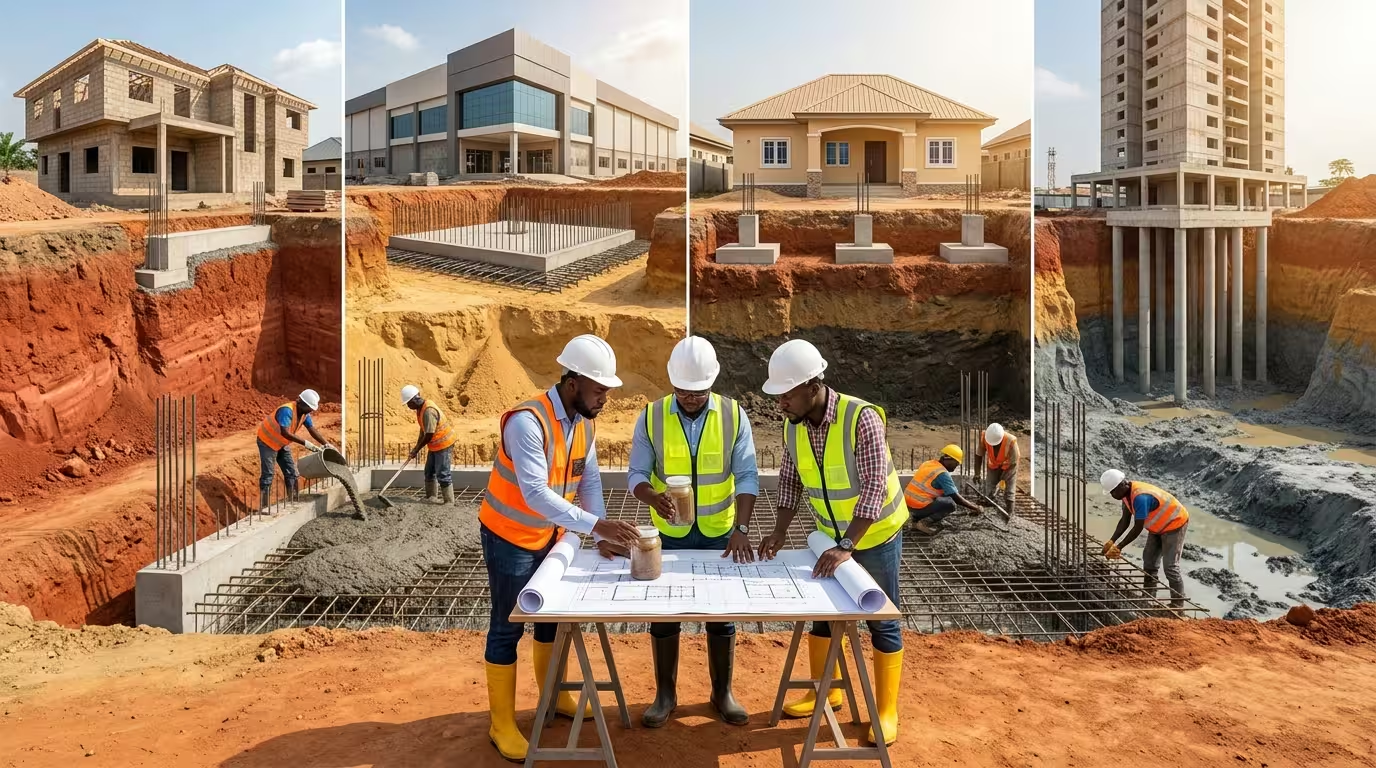
Why Soil Testing Should Always Come Before Construction
The biggest mistake property owners make is assuming that all land is equal and can be used for the same type of foundation. Even two plots of land can be adjacent but have entirely different soil properties.
A simple strip foundation can be used to support a two-story building. The latter may need deep-piled foundations that penetrate many meters into the ground.
If they don’t investigate, you will never know. That’s why it’s crucial to undertake geotechnical or soil testing before construction.
A soil test can be used to find out:
- Soil type
- Bearing capacity
- Groundwater level
- Settlement risk
- Moisture behaviour
- Foundation recommendations
If you opt out of this process, you might save on the money, but you’ll be spending plenty of money in the future for repairs. Have you ever witnessed buildings cracking in a short time after they have been erected?
Most often, it’s the result of a bad foundation or from soil conditions that the foundation was not designed for.
Understanding Common Soil Types in Nigeria
The geography of Nigeria gives rise to a number of soil conditions in Nigeria. The specific characteristics of each soil vary in response to building loads.
Laterite Soil
Laterite is the most prevalent soil for building in Nigeria. It is easily recognized by its red color.
In fact, laterite is very compacted and stable when compacted properly, and it is suited as a good foundation material.
Advantages of Laterite Soil
Good load-bearing capacity
Easily compacted
Widely available
Relatively affordable to work with
Challenges
Laterite is good in normal cases, but the excessive water can make it weak. Drainage is now of paramount importance.
The laterite soil may be progressively weakened in the site, causing settlement issues when the site is poorly drained. As a result, site grading and drainage facilities should always be provided with construction on laterite soils.
Sandy Soil
In coastal towns like Lagos and certain areas of the Niger Delta, sandy soil is prevalent. Rapidly drains water.
This may seem like a good thing at first glance. And it is. However, there is another facet of the issue. Sand particles do not strongly bond to each other like clay or laterite. This means that if a heavy load is placed on sandy soil, the soil can move if the load is not compacted.
- Sandy soil has several advantages.
- Excellent drainage
- Very little swelling and shrinking.
- Easy excavation
Challenges
- A weaker integrity when free of attachment
- Prone to erosion
- Requires proper compaction
- On sand, foundation sizes are often increased or raft foundations are installed to better distribute the loading.
Clay Soil
This is also very different in clay soil. This becomes more complex. Clay can readily absorb water. It swells when it gets water. It shrinks when dry. Now think of inflating and deflating a balloon many times.
Now visualize a building on top of the movement. A structure can be subjected to a lot of stress due to this constant expansion and contraction.
Clay Soil Problem:
Foundation movement
Wall cracks
Uneven floors
Differential settlement
The soil properties make clay soils prone to the use of more robust foundation systems, like raft and pile foundations.
Black Cotton Soil
The black cotton soil is one of the most troublesome soils for construction purposes. It is found in several northern states.
It is a type of soil with large expansive clay minerals, which exhibit large seasonal movements. The soil volume increases greatly during the rainy periods.
It shrinks during dry spells of the year. The resulting movement may be so great that it can cause damage to buildings if the appropriate foundation system is not employed. Therefore, when black cotton soil is found, engineers recommend using raft or pile foundations frequently.
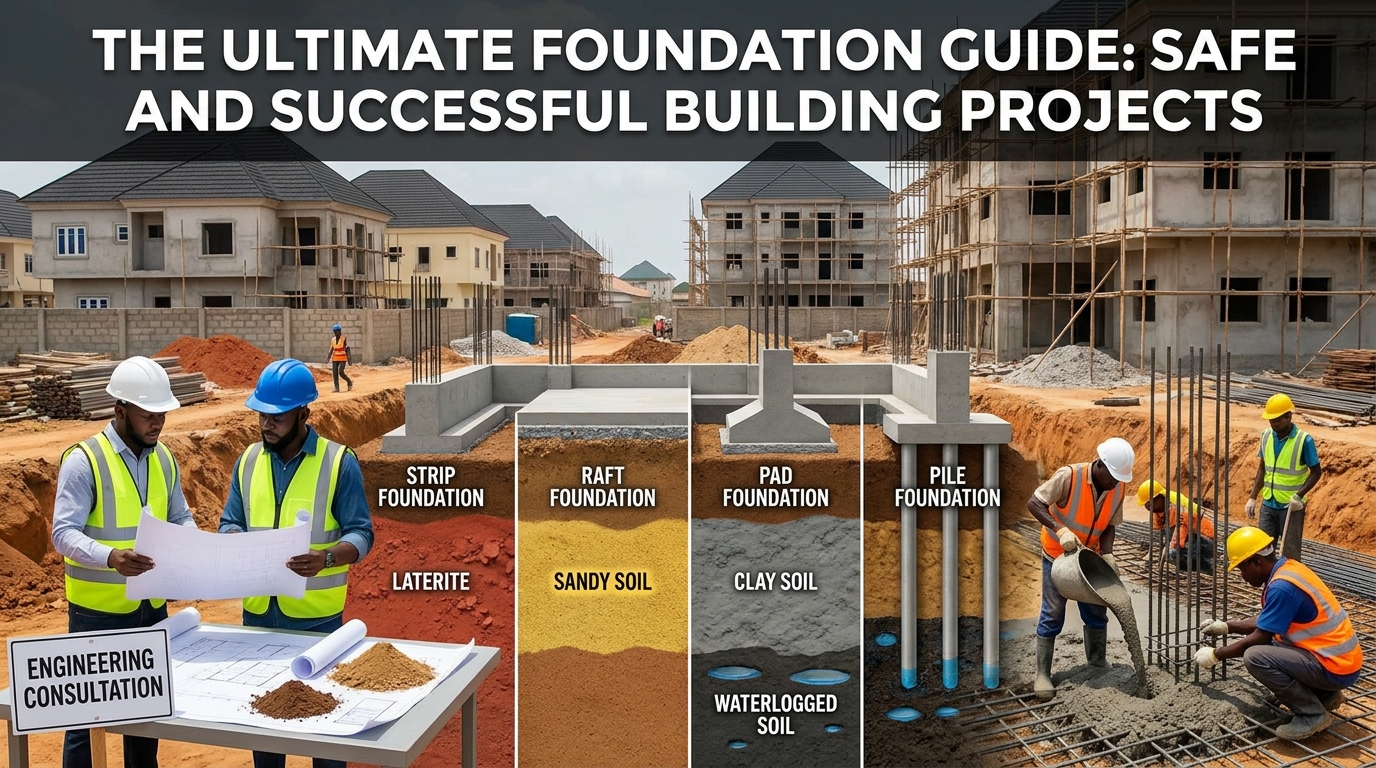
Strip Foundation
The foundation used in Nigeria for residential buildings is probably the strip foundation. If you built or visited any kind of typical bungalow building site, you’ll have noticed one.
A strip foundation is a continuous strip of reinforced concrete under load-bearing walls. The weight loading for the building is distributed instead of being concentrated at one point.
Characteristics of strip foundations.
- Continuous concrete footing
- Reinforced with steel bars where necessary
- Built under load-bearing walls
- The depth is variable depending on the soil condition.
Benefits of Strip Foundation
- Cost-Effective
- Affordability is one of the key reasons why property developers favor strip foundations.
There is an advantage for strip foundations over raft or pile foundations:
- It does not demand the same amount of concrete, steel, and labor.
- This greatly lowers the total construction expenses.
- Easy Construction
- The building process is easy.
- Excavation is easy, and special equipment is seldom needed.
- Ideal for numerous residential projects.
- Strip foundations may also be adequate for bungalows, semi-detached houses and small commercial buildings.
Limitations of strip foundations:
- Not all are appropriate in all locations.
- In soils with low bearing capacity, inadequate support is possible with strip foundations.
- Swampy and/or unstable areas require deeper foundations.
Raft Foundation
A raft foundation (also known as a mat foundation) is a thick reinforced concrete slab that spans the entire or a substantial portion of the building’s plan area. The whole building is built on just one large foundation platform, instead of separate walls.
Consider it as putting a heavy item on a tray rather than on small supports. The weight is spread out across the tray.
Characteristics of raft foundations:
- The large reinforced concrete slab
- Uniform load distribution
- Extensive steel reinforcement
- Extends over the entire building area
Advantages of Raft Foundations
Reduces Differential Settlement
Differential settlement is one of the most common factors causing structural damage.
This is a condition where various components of a structure settle at varying rates.
With raft foundations, the risk is reduced as the building is one single structural unit.
Excellent for Weak Soils
Raft foundations can be used in areas with varying or poor soils because they increase the bearing area and decrease the load on the soil.
Improved Structural Stability
Buildings built on raft foundations are likely to have fewer settlement-related issues.
Disadvantages
The most significant disadvantage is the expense.
- Raft foundations require:
- More concrete
- More steel reinforcement
- More skilled labour
But, if soil conditions require extra assistance, it can sometimes be worth it.
Pile Foundation
When the soil near the surface just can’t support the building, what do you do? This is where pile foundations are needed. Pile foundations distribute loads to the more stable and stronger layers of soil at greater depth. The building is not relying on weak surface soils but is anchored to competent soils below.
What’s the depth of the piles? The depth of the piles can vary from a few meters to more than 50 meters below ground.
Types of Pile Foundations
Driven Piles: The precast piles were driven into the ground.
Bored Piles: Concrete is filled in drilled holes.
Friction Piles: Carry loads by friction between the pile and soil.
End-Bearing Piles: Transfer loads directly onto hard rock or strong soil layers.
The benefits of Pile Foundations
Appropriate for poor soils
Pile foundations are very successful in swampy or waterlogged soils.
Supports Heavy Structures
Useful for:
- High-rise buildings
- Hotels
- Shopping complexes
- Bridges
- Industrial facilities
- Minimal Settlement
- Settlement hazards are greatly minimized as loads are transferred to stronger soil layers.
Disadvantages
Generally, pile foundations are the most costly alternative to building a foundation.
They also require specialized equipment and experienced contractors.
Pad Foundation
The pad foundations are used to hold up single columns and not walls. They are each supported by separate reinforced concrete bases. A commonly seen type of pad foundation is found in framed structures and warehouses.
Advantages
- Affordable
- They are smaller than larger foundation systems and require less material.
- Quick Installation
- The construction is not difficult, and the process is relatively quick.
- Ideal for structures that need to be lightweight. Perfect for lightweight structures.
They work well for:
- Bungalows
- Warehouses
- Security posts
- Carports
Limitations
Stable soil conditions are needed. Support pad foundations.
Large pads or other foundation systems may be needed for poor soils.
The Bottom Line
No one-size-fits-all foundation. The following factors are critical for the right foundation:
- Soil type
- Building size
- Structural load
- Groundwater conditions
- Budget
Strip foundations are suitable for stable soils. Raft foundations work better on less dense soils.
Under difficult soil conditions, pile foundations offer maximum support. For lighter structures, pad foundations continue to be a cost-effective choice.
Don’t buy blocks, roofing sheets, or finishing materials until you know your soil’s characteristics.
In construction, it is always the strength of what lies beneath that determines the strength of what is being built above.
Still have questions?
Navigating the real estate market can be complex. Head over to the iPropty Q&A hub to get expert answers, or ask your own question today!
Explore the Q&A Hub