
The Lagos-Calabar Coastal Highway has been a source of excitement and controversy in Nigeria, as it has become one of the country’s most prominent infrastructure initiatives. The project is set to revolutionize transportation in southern Nigeria. Meanwhile, it has caused widespread concern for demolition. The situation has become even more critical for the proprietors of property located along the corridor. There is a lot of interest in which properties are impacted. Others want to know if there’s any sort of compensation.
The Lagos/Calabar Coastal Highway is one of the projects of the federal government. The length of the proposed road is about 700 kilometers. It will link up Lagos with Calabar via seven coastal states. The journey traverses Ogun, Ondo, Edo, Delta, Bayelsa, Rivers, Akwa Ibom, and Cross River. It is a game-changer economic corridor, say government officials. But there have been high costs for communities impacted by the building.
The heart of virtually all the conflicts is the project’s right-of-way. This is the legal right-of-way dedicated to making road development. Some buildings in this corridor may have to be demolished. One of the key issues that people are debating is the setback requirement of 150 meters. Residents have been ordered to evacuate if they are inside this setback zone, officials say. Communities throughout the corridor have been impacted by this requirement.
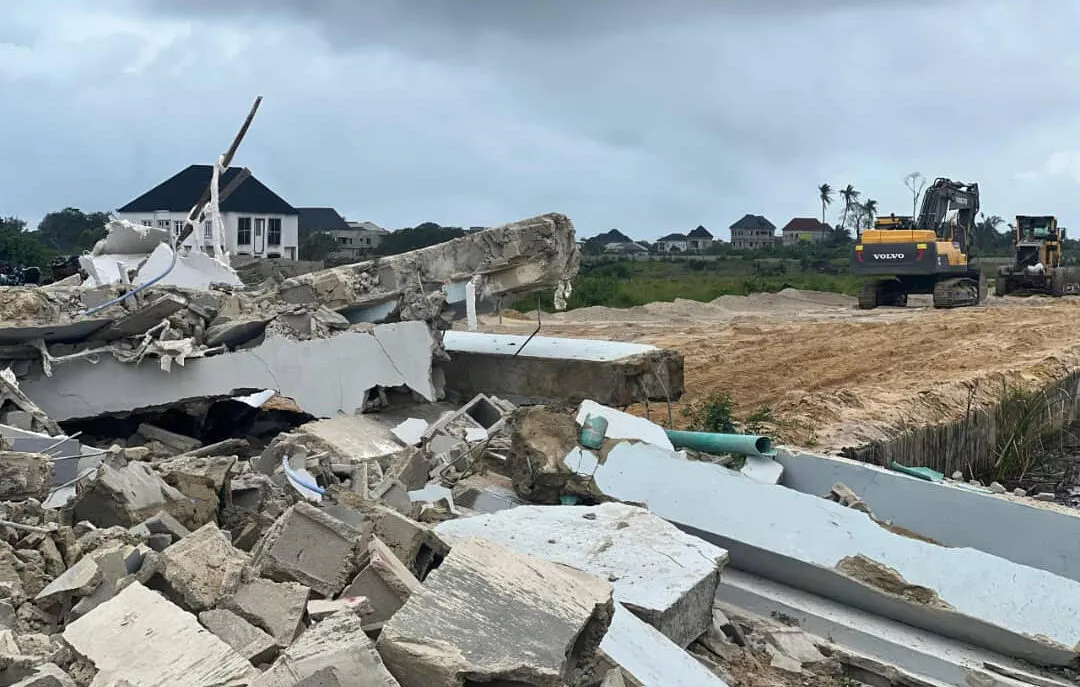
The setback rule is becoming more and more controversial. It has gone through a number of transformations during the course of project implementation. This has left some previously “safe” communities vulnerable. Uncertainty among property owners has been caused by repeated realignments. The residents, who managed to escape the earlier demolitions, have once again been marked. This has aggravated concern amongst affected communities.
Over 32 local communities have been impacted in Ibeju-Lekki, reports said. These are Eleko, Iberekodo, and Igando Oruju. The displacement of many of its residents has already taken place. A couple of communities had earlier diversions and adjustments to their roads. Some have been spared demolition because of their relocation. However, new setbacks have led to fears of displacement being once again forced upon residents.
The first big demolition was in the vicinity of Victoria Island and Lekki. The first three km of the highway were dealt with in this section. It is still the best recorded phase of the project. During this phase, the federal government paid a compensation of ₦2.75 billion. These funds were for properties within the first three kilometers. The owners within the gazetted corridor received payments.
The Federal Controller of Works, Olukorede Kesha, confirmed the process of compensation. These payments to affected property owners were said to have been made using official channels. There was compensation for private developments as well as businesses. There were several significant developments that were impacted at this point. The beneficiaries were Landmark Group, Kids Club, Maxtivity, and Bolaji Areyoh. These cases received much publicity.
Of the latter, Landmark Beach Resort was the most famous to be pulled down. The resort was located on a strategic beachfront. The argument that it should be removed was popular throughout the country. The Minister of Works, David Umahi, defended the government. He said that the beach was never legally part of Landmark. The government took land back from the people, he said.
The minister also said that there were some discretionary compensation payments. He insisted that some tenants were not entitled to the property. However, in a few instances, compensation was still made. The issue of coastal development spread beyond the beaches. A second conflict arose between the residential and commercial investors. These owners said that the road alignment has changed unexpectedly.
Public protests were led by the Coalition of Civil Rights Against Impunity. Members complained about the destruction of investments in the millions of dollars. They also asked for monetary damages for the property owners. The controversy came to the fore after the Minister of Works made his remarks. Attorneys presented evidence that the route of the road was significantly altered. This is said to have had an impact on homes beyond the initial path.
Affected foreign investors were represented by lawyer Tahir Ahmad. He said that the road was rerouted because of buried communication cables under the sea. It is said that one of these cables was MTN’s. This prompted questions regarding the right to property as enshrined in the Constitution. Compulsory acquisition is regulated by Section 44 of the Constitution of Nigeria. It must be due process and must be with compensation.
The law requires that the authorities give formal revocation notices. The acquisition of property should also be for the public good. Any compensation ought to be granted according to lawful acquisition procedures. For diaspora investors, it was the issue that gained heightened significance. Some Nigerians in the diaspora heavily invested in the real estate market on the shores of Lagos. Now these investments are at risk.
Investor groups urged to expand the stakeholder group. They said investor confidence is built on the basis of legal certainty. Legitimate investments continue to be an important issue of concern. There were also community-level conflicts in Okun-Ajah. Civil society groups have called for compensation for homeowners affected. Many residents complained they were unfairly affected.
These homes were simply normal houses, unlike the luxury developments. Unexpectedly, families were in the expanding boundaries of projects. This caused further difficulties. Currently, the most serious concerns are in the Ibeju-Lekki communities. Numerous settlements predated the highway project. Residents say they have long roots in the communities.
Past demolitions drove people out of entire villages, say community leaders. Some houses date back to before modern construction. A large amount of investment has been made in development by the residents. Local leaders say compensation is an issue that is still up for debate. Between ₦9 million and ₦10 million is reportedly what some families have received. Some people say that these quantities are too low.
The cost of land has gone up drastically in Ibeju-Lekki. Citizens claim you can’t buy back your property with money. Costs of relocation add to this burden. Other complaints include inequitable pay practices among residents as well. Some of the crop owners reportedly were paid. But, according to homeowners, building compensation is still insufficient.
In February 2026, new issues arose. The authorities reportedly started enforcing the 150-meter setback. This brought back some concerns in multiple communities. Local leaders called on the government to take action. They asked for a halt to more demolitions. Others requested to be exempted from the requirement for older settlements.
Significantly, there are many who are in favor of the highway project itself. The main problem they face is that the demolition boundary is getting larger. They are afraid that entire communities might be wiped out. The community leaders are saying a 150-meter setback on either side of the community will be a disaster. Heritage sites, homes, and shrines may disappear. The entire settlement can disappear.
Many residents say they’re not against development. Rather, they are interested in balancing infrastructure and community conservation. They think that the width of the roads they have is adequate. The compensation is still climbing, even as construction works continue. President Bola Tinubu announced that ₦18 billion has been paid. This is an indication of the project’s growing reach.
This is a significant rise from previous payments. This also emphasizes the extent of properties affected. Additional communities have joined the compensation process.
Another problem relates to approving developments near the corridor. President Tinubu cautioned against illegal roadblocks on federal roads. Previous approvals may be revoked. Many property developers were shocked by this news. Several projects were approved by the state government a long time ago. However, the approval does not necessarily mean that protection is guaranteed.
Documentation is important for property owners covered by the agreement to determine if they are eligible for compensation. Legal title holds a key importance. Good approvals are extremely significant as well.
Legally strong properties tend to be those that have valid titles. These certificates can be Certificates of Occupancy and Governor’s Consent. Registered Deeds also enhance the claims to ownership. The applications for planning approval are also important. Approved layouts are not on the list of hazard risks. Such developments may be deemed illegal structures by authorities.
Development is subject to control by the Lagos State Physical Planning Permit Authority. The agency will be able to clear out unauthorized constructions. The zones for coastal protection are subject to even more rigorous scrutiny. Now, as per the existing laws, compensation is given if there have been lawful acquisitions. Typically, illegal developments are not eligible. This separation is what makes for many outcomes.
The real estate community warns consumers of continued risks. Ibeju-Lekki and Epe are specially highlighted. This is the reason why these areas are susceptible to acquisitions in the future.
A significant number of buyers are interested in relatively cheap land. Unfortunately, some plots are in the government acquisition areas. Such properties may be reclaimed without compensation. The big message of the lesson is obvious. The project has a footprint that has changed several times. Original alignments are not always in place.
Conflicts have occurred in each of the phases from Victoria Island to Ibeju-Lekki. The issue of compensation is still arising. Property owners are in a constant state of uncertainty. Due diligence is a required process for investors and homeowners. It is important to double-check approvals, titles, and survey status. It’s expensive to make an assumption.
Most importantly, it is important to pay attention to the proximity to the corridor. A property located outside of today’s construction area may not be undisturbed. Up-to-date governmental surveys offer the best guidance. Property owners need to be kept informed as the Lagos-Calabar Coastal Highway is being advanced. The project will have tremendous economic value. But its effect on neighboring property remains to shape communities throughout Lagos.
Still have questions?
Navigating the real estate market can be complex. Head over to the iPropty Q&A hub to get expert answers, or ask your own question today!
Explore the Q&A Hub