Completed houses have been handed over to the beneficiaries of the Renewed Hope Housing Program. It was done by the federal government in Abuja. The development is another step on Nigeria’s path. Which is to say, making homeownership more affordable. This stage is different from the previous announcements. It is being made on completed homes and occupied communities. The handover showcases tangible development of the national housing program. It also shows the government’s dedication to turning promises for housing into reality.
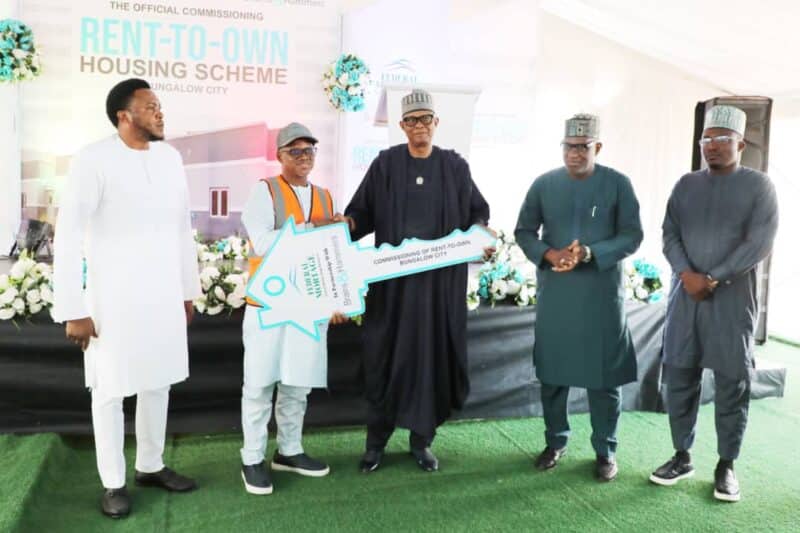
The official commissioning ceremony was held at Bungalow City. Tuesday, June 23, 2026. The estate is situated on the expressway called the Dei-Dei–Zuba Expressway in Abuja. In the ceremony, the beneficiaries of the Rent-to-Own Housing Scheme were given the keys to the new house. It was the first significant public housing sale under the new leadership of the Federal Ministry of Housing and Urban Development. It also demonstrated a move from the groundbreaking to the completion of the project.
The Minister of Housing and Urban Development, Engr. Muttaqha Rabe Darma, PhD. The keys to the new homeowners were given out by Muttaqha Rabe Darma in person. His involvement was a sign of the government’s efforts to keep its pledges for housing. The completed dwellings were built by Brains & Hammers Limited. The Federal Mortgage Bank of Nigeria (FMBN) provided the funding for the project. The development has been implemented as a public-private partnership (PPP).
One of the flagship schemes under the Renewed Hope Housing Program is still the Rent-to-Own Housing Scheme. The program leverages public-private partnerships. This is to boost the supply of affordable housing in Nigeria. It also aims to offer sustainable homeownership to low and medium-income earners. This model brings together government and private sector developers to support the build-out of housing. The Bungalow City project is a good example of this partnership being realized in actual housing units.
The handover of the day has extra political and administrative weight. Engr. Darma became minister on 28th April 2026. He vowed to make project completion and delivery of dwellings his top priority when he was elected as president. Within two months, the Bungalow City handover was accomplished. This speed of delivery was an early sign of continuity in the face of changes in the ministry.
After Arc’s resignation, Darma got the position of minister, Ahmed Musa Dangiwa, in April 2026. When leadership changes happen, it can bring uncertainty into the continued government projects. The handover, however, was successful. Which indicates continuity in the implementation of the housing program. The ceremony thus turned out to be more than just a normal commissioning. It was also a testament to the continuity of project execution. Despite the face of changes in administration.
The event was described as a key milestone for the Renewed Hope Housing Program by the officials. Some housing projects were often the subject of groundbreaking ceremonies. However, for many projects, this failed to pave the way to completion. For the Bungalow City delivery, therefore, it is quite a different ball game. With completed homes now taking over the spotlight from prior announcements, there is plenty of activity going on.
The Federal Mortgage Bank of Nigeria was a key financier of the project. The bank supplied financing, which allowed the construction under the PPP option. In this ceremony, the managing director of FMBN reiterated the commitment of the institution towards affordable housing. He gave the beneficiaries his congratulations on becoming homeowners. He also vowed to support the provision of greater access to affordable housing in the country.
The managing director/president has also championed the bank’s activities. Majorly towards the President’s Renewed Hope agenda. He says home ownership is still a national priority. And it’s achievable at reasonable prices. He said FMBN will remain to champion the house-building initiatives. This will be done by means of sustainable financing mechanisms. The interventions seek to improve the home ownership aspirations of Nigerians. It will be achieved by lessening obstacles to home ownership. They also reinforce confidence in government housing programs in the longer term.
The beneficiaries also expressed their gratitude at the commissioning ceremony. Barr. The voice of the new homeowners was Sanusi Seidu Dantsoho. He thanked the federal government for providing him a way to become a homeowner. He commended the government’s efforts to create more affordable housing across the country. His remarks were indicative of the excitement that was felt among the beneficiaries.
The Federal Mortgage Bank of Nigeria also got a mention of Dantsoho. He said the bank is an essential institution that boosts home ownership in Nigeria. For many prospective homebuyers, he said, financing remains a significant need. And it must be affordable. Many Nigerians would find it difficult to buy homes without having access to mortgages. He thus commended the bank for the support given to the program.
The beneficiaries also vowed to defend their new community. Barr. Dantsoho promised the minister and project stakeholders their cooperation. Residents would cooperate to ensure peace and order, he said. They also agreed to maintain the facilities and environment of the estate. He added that good community management is still very critical in terms of sustainability.
A large program, however, that includes the Bungalow City project. The entire Renewed Hope Cities and Estates Development Program started in February 2024. The national framework set high targets for housing provision in Nigeria. It also brought a formalization process for housing development throughout the country. Different income groups are catered to by different financing models in each project.
As per the original plan, each Renewed Hope City will include at least 1,000 residential units. The cities are distributed across all the geopolitical zones of Nigeria. Another city is also allocated to the Federal Capital Territory for the FCT. Renewed Hope Estates, however, focuses on the remaining 30 states. The estates have between 250 and 500 dwellings.
The estates are particularly geared towards low and medium-income earners. There is a range of housing options available, from one- to three-bedroom semi-detached bungalows. Flexibility was also built into each development by the designers. Organic building designs enable future expansion as households’ incomes rise. This means that homeowners can expand their homes incrementally without having to move.
In this method, one-bedroom homes can ultimately be changed into two-bedroom houses. Later, those homes can be used as three-bedroom houses. This option is beneficial for families that are expanding and are facing fluctuating economic conditions. It also decreases pressure on homeowners to buy bigger homes right now. Rather, when family income rises, they can make improvements to their existing homes.
Several financing possibilities have also been incorporated in the program. The Federal Mortgage Bank of Nigeria offers mortgage loans at single digits to eligible subscribers. This mortgage may be for a period of up to 30 years. In addition, subscribers can opt for rent-to-own plans that are available to pay monthly, quarterly, or annually. Alternatively, higher-income buyers can buy homes without a loan.
President Bola Ahmed Tinubu has recently given a new report on the progress of the programs. His comments were made just two weeks before the Bungalow City handover. The president says the administration will go on making 100,000 homes available across the country. The first implementation phase will be aimed at 50 thousand housing units. Work is ongoing at several sites.
The President announced the achievement of over 3,000 housing units, flagging off in Karsana, Abuja. He also reported significant gains in Lagos State. The construction of 2000 units of Renewed Hope City in Ibeju-Lekki is now well advanced. The selling of houses in that development has already begun. These projects are examples of projects that are continuing to expand outside the Federal Capital Territory.
President Tinubu also disclosed that the construction of more than 15,000 housing units across the country is underway. This is a current count of implementing states. Ongoing construction is taking place in line with the overall national housing framework. The projects are all part of the administration’s housing goals. They also have momentum increases at several locations.
Apart from construction, the government is tackling the structural issues of the housing sector in Nigeria. One priority is to enhance the titling of land across the country. Another is related to the increase in financing opportunities for construction. The government is also enhancing the leasing of equipment for developers. Standardization of housing prices is also a key reform priority.
The administration is confident these changes will make the housing market more transparent. The standardization of pricing can help minimize corruption in project implementation. Better land documentation could also boost investors’ confidence. Improved financial deals may allow for more involvement by the private sector. The reforms come together to establish an efficient housing system.
The government’s strategy continues to be focused on housing finance, too. President Tinubu spoke about the effect of the MOFI Real Estate Investment Fund. He says the program has helped 1,859 families in 25 states to qualify for home loans. These loans amount to ₦128 billion. The loan has a 20-year term and an interest rate of 9.75%.
MOFI financing is quite different from conventional commercial mortgage products. The rates of commercial mortgages in Nigeria are often in the range of 25-30 percent. Such rates historically have restricted formal homeownership opportunities. The MOFI scheme has significantly lower borrowing rates. Which is compared to the rates offered in the conventional scheme. This disparity makes it more affordable for a lot of Nigerians who are eligible for these.
Likewise, the Bungalow City project has single-digit mortgage financing from the NHF. Together with rent-to-own schemes, these are all possible ways of owning. Reduced financing costs mean that subscribers have less burden in the long run. Thus, there is a realistic possibility for Nigerians to become homeowners. One of the program’s greatest strengths is thus its financial access.
The Bungalow City handover is a unique Renewed Hope milestone. Previous events tended to be about what was coming up next. This ceremony, however, was used to mark the completion of the houses and their occupancy. Keys were given out to beneficiaries when they moved into their new homes. The experience proves this and helps build trust in the program.
In the end, the pilot program is intended to provide 100,000 finished housing units across the country. These homes will be for low and medium-income Nigerians. There are two types of purchases. The outright and mortgage financing and a rent-to-own subscription. Participants of the program include civil servants, traders, artisans, and commercial drivers. Internationally displaced persons (IDPs) across Nigeria are also beneficiaries.
The success of the program in the long term is highly dependent on deliveries. Much rather than announcements. The introduction of groundbreaking ceremonies does not solve Nigeria’s housing problem. Progress toward sustainability depends on homes being delivered to intended beneficiaries. The June 23 handover of the Bungalow City is thus a significant milestone. Success in the future will be judged by the number of deliveries completed. As well as the 15,000 units in construction and the national 100,000 home delivery goal.