Many buyers get confused because these measurements sound easy. However, few know how they relate practically.
This can cause issues because of the mistaken beliefs about land size. Which can in turn cause poor investment choices. By knowing these measurements, you can make confident property offers. You can also prevent costly mistakes in property transactions.
One of the common questions asked in the real estate industry in Nigeria is how many plots constitute one hectare. At first glance, the answer seems straightforward. But there are a few considerations to take into account. And this is based on location and planning requirements.
Specific reference to hectares will help to grasp the basic units of land measurement in use across Nigeria. With knowledge of these units, property comparisons will be much simpler when making a purchase.
What a “plot” means in Nigeria
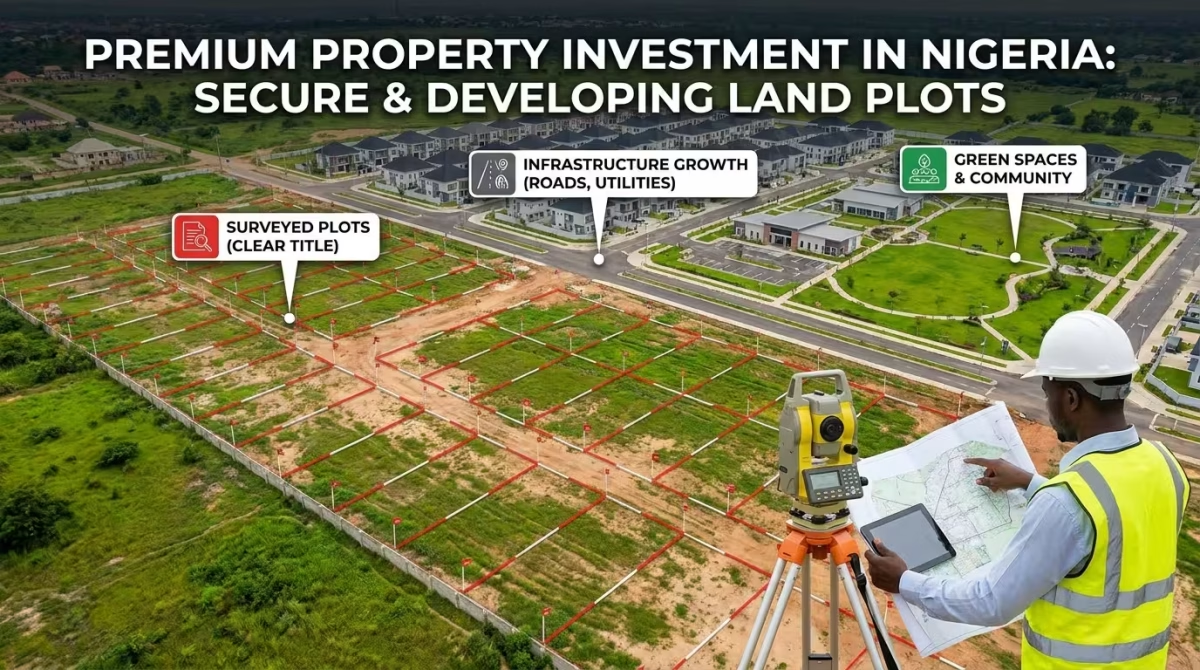
A plot is the most prevalent piece of land sold to residential property buyers in Nigeria. When it comes to land involving non-public entities, the majority of the land deals will mention plots. They mention plots rather than bigger measurements.
But there is an important point that confuses many first-time buyers. And this is that here isn’t one size of plot across the country. The size of plots can vary. Ranges from government planning requirements, estate design, and local development needs.
Typically, residential development happens on a plot of land around the size of a 50′ x 100′ lot. This is equivalent to approximately 464.5 m² in metric measurement.
Some speculations and high-end developments use larger dimensions. In order to better fit modern housing design. In some places like Lagos and Abuja, the plots are also about 60 x 120 feet.
This is a reason why seasoned investors never use the term ‘plot’ in negotiations. Rather, they will always ask for the exact measurements or survey plan. Most of them do this before committing any financial resources.
This allows for no mistakes and no confusion; people know exactly what it is they are buying. This simple check can help the investor avoid costly mistakes later on.

So what is a hectare?
One hectare is a set standard measurement used in real estate. It is also used in land surveying and agriculture. Unlike plots, hectares have a consistent size. Irrespective of their location and/or type of development.
One hectare is equal to exactly 10 thousand square meters and is much larger than an average house lot. Hectares are commonly used by surveyors, governments, and large developers in reference to large tracts of land.
Hectares are used to provide consistency. This allows a comparison between various properties in different regions without confusion. Hectares are therefore preferable to the investor. It makes it easy to assess large developments or commercial projects.
When you are looking at estate master plans, land for agricultural use, or document allocation by government, you might come across hectares. During these times, comprehension of the conversion can be very useful.
So, How Many Plots Make One Hectare?
The general consensus in the Nigerian real estate market is that the 15 plots make up one hectare. This estimate is regularly used in development planning. It is often used in land use allocation and property marketing documents.
But it is important to know why this figure is so to make land transactions less uncertain. The calculation will be based on the size of the plot being used, which is significant.
One hectare contains about fifteen plots. When compared to the standard plot, which is about 60 feet by 120 feet, or about 669 square meters. The 10 000 square meters divided by 669 square meters equals approximately 14.9 plots.
In the practical planning, surveyors/developers round this figure to 15 plots. This is an approximation that has become common amongst the real estate industry in Nigeria.
However, when other dimensions of plots are used in a development area, calculations will change. The smaller the plots, the more units they will accommodate on a hectare.
For instance, if the plots are roughly 464.5 square meters (50 x 100 feet), then there are approximately twenty-one or twenty-two plots in one hectare.
This is the reason why the answer given by different people may be different. Each person talks about hectares and plots. Either answer can be right based on the plot size in question.
What is the reason these 15 plots per hectare are still used by many developers?
People are always asking why 15 plots is still the industry norm. Despite differences in mathematics between plot sizes. The reason has a lot to do with the estate planning needs.
Developers are required to reserve areas for roads. For drains, other utilities, and public infrastructure. This has to be done when designing estates. These features influence the number of land units available for sale in the total land area in a negative way.
Therefore, the potential number of plots on a hectare may be greater, but fewer realistic plots may be available due to infrastructure needs. Fifteen plots per hectare is thus considered the industry standard for planning purposes.
This has the benefit of making project planning easier. Also enabling a more realistic picture of the use of land to be seen. This is something that the buyer will see a lot of when viewing homes for sale on an estate.
The relation between plot, acre and hectares
It is important to understand how these measurements relate to each other to get a clear idea. Land units perform a specific function in land transactions and planning of development.
An acre measures about 4,046.86 square meters in size, located between a plot and a hectare. An acre typically includes approximately six plots of 60 x 120 feet.
A hectare, on the other hand, is about 2.47 acres or 10,000 square meters. This connection accounts for the fact that a hectare fits many more plots than an acre.
These conversions may prove useful when comparing the properties that are being marketed in different units. While having to make assumptions, buyers can make accurate comparisons in real-time.
Why land measurement knowledge is important.
Land measurement knowledge is more than a mere academic understanding. It is directly linked with investment results. Each square meter has an impact on the value of a property. On its development potential and future profitability.
If the buyer is familiar with measurements, then they are able to quickly decide. Make choices whether or not an advertised property is fair value. This knowledge also enhances negotiating positions. Because buyers who know how to get the best value out of a deal are easily known by sellers.
Knowing measurements also aids in the analysis of plans and legal documents in the course of due diligence. Buyers do not have to rely on third-party explanations.
It is more beneficial to investors who intend to use the plot for agricultural or commercial development or for residential estate development. Precise land calculations aid in budgeting, design planning, and project execution.
Final Thoughts
How many plots will be in a hectare? It seems an easy question. But the answer varies a great deal based on the size of the plots and development standards. In the Nigerian real estate sector, one hectare is usually considered to be about 15 plots.
But, if calculated mathematically, this number can be quite high for smaller plot sizes. This reality makes it vital to validate actual measurements. Also, relying on generalizations, i.e., general measurements.
When buying land, have a survey plan drawn up and check the actual measurements before you buy the land. Knowing about plots, acres, and hectares will enable you to make sound decisions. It helps you to avoid costly errors.
After getting to know just a little bit more about land measurements, it will be easier to assess opportunities with confidence. With properties being so competitive in Nigeria, that knowledge could mean the difference. The difference between a successful investment and an expensive mistake.