
Millions of Naira are lost by Nigerians yearly in land transactions that are never legitimate. All those losses could have been avoided by just one document check.
Losing one’s land after years of savings should not be a thing that should be experienced by any Nigerian. But it is happening again and again because buyers are missing a crucial part of the process—the land survey search. Some believe the salesman. Many others take it for granted that a land with a survey plan is clean. The first is that it’s very risky, and the second is it costs real money in the long run.
A land survey search can be the savviest investment that your money can make, whether you are a first-time home buyer, an investing veteran, or a property developer. It verifies your location, exposes fraud, exposes government acquisition, and provides facts before you give a single naira. This article will demonstrate how to do it.
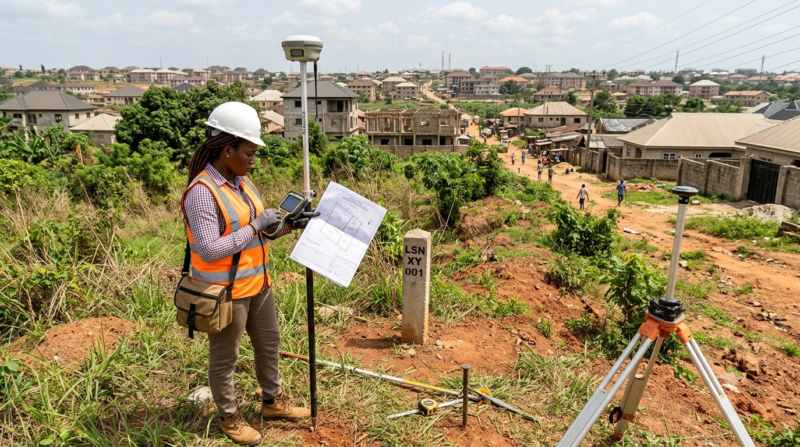
What is a Land Survey Search?
A land survey search is a verification process of a property’s plan of survey by a government office. This power is usually held by the Surveyor-General in the state in which the land is located. The search establishes that the survey information is correct and the land is officially registered. It also shows if there are any disputes over the land that has been acquired by the government or restrictions on development.
A survey plan is not synonymous with a land survey search, and this can cost money for the buyer. A survey plan is a representation that includes measurements, coordinates, and boundaries of a land parcel. A land survey search establishes whether the information is accurate and whether or not the property can lawfully be sold. One is a document. The other is to confirm the authenticity of the document. Before paying anything, you have to give both of them.

Why can’t you skip this step?
All rationale behind doing a land survey search is tied directly to money, safety, and serenity.
First, it verifies the exact location of the land you want to purchase. Sometimes, fraudulent sellers have a plot and then sell it to the potential buyer again. The survey search does just that and can keep you safe from that scam right away.
Secondly, it establishes the scale and limits of the land accurately. If you know the size, there won’t be any conflict with neighboring owners. In addition, you are guaranteed that you will get what you paid for without any hassle or confusion.
Third, it shows you that the government is acquiring the property, and there’s nothing more devastating to a buyer than finding out after the purchase that the government has bought the property. The government has the power to take back land at any moment, and no one who buys it will be able to claim any rights to it. A survey search is going to tell you this at first, before it’s your problem forever.
Fourthly, it recognizes where there are overlapping surveys and ownership conflicts. Occasionally, the same land is claimed by more than one person. This conflict is revealed to you by a proper search before you unwittingly purchase your way into a legal conflict.
Fifthly, it helps to verify the authenticity of the survey plan that you are holding. Fraudsters often create phony survey plans, and they will always target unwary buyers. Surface authenticity is uncovered by verification through the Surveyor-General’s office.

Step one: Request the Survey Plan
Ask the seller to share a copy of the plan of the survey of the property. This document should be a product of a true seller, and they should give it willingly and immediately. Any resistance or excuses at this point are serious indicators that you should take.
Step Two: Carefully check the survey details.
Take time to check all points on the survey plan. Verify survey number, beacon numbers, coordinates, survey date, and registered surveyor’s official seal and signature. Any missing information, inconsistency in information, or anything that appears to be altered should be a cause for immediate concern. Don’t just shrug off red flags—look into them.
Step Three: Go to the Office of the Surveyor-General
Take the survey plan to the Surveyor-General’s Office in the state where the property is located. This is the only office that can do an official land survey search. Try to obtain verification from unofficial sources or third parties only as part of a team effort with others. Get off the beaten path.
Step Four: Submit Survey Plan for Verification
The records of the Surveyor-General’s Office will be cross-checked with government records. They verify the legal status of the property by comparing the submitted survey plan with the records that are registered. This comparison will help you to distinguish when you’re looking at actual land and when you’re seeing fake paperwork.
Step Five: Verify the Land Status
The search result will categorize the land. The land is either not acquired by the government, acquired by the government, committed to be acquired by the government, or undergoing excision or gazetted land. The only land that can be safely acquired without further legal advice is land that has been confirmed as being free from government acquisition. Other statuses call for professional advice before you proceed.
Step Six: Physical Site Visit
Search is not a substitute for physical inspection of the system. Visit the property after searching to verify that the description from the survey plan and what is seen on the ground are correct. Check surrounding buildings and look for boundary markers, and inspect the land itself. Sometimes it is more than a story that can be told through a document; it’s a story that can be seen.
Step Seven: Check other documents
Don’t limit your search to the survey search only. Check title documents, deed of assignment, and certificate of occupancy as applicable. The various documents have various protective functions in the buying process. If you do a joint search, you will get a full picture of the status of the land.
Step Eight: Seek professional advice.
Do all of this in conjunction with a registered surveyor, a qualified real estate attorney, or a trusted real estate firm. These professionals are capable of understanding survey results with precision and will be able to recognize risks beyond the scope of what a layperson would. Whether or not it comes to the price, expert advice is always less expensive than post-purchase land dispute resolution.
The Bottom Line
Don’t take a chance on purchasing land without a survey search—it’s a risky move, really. Each year, Nigerians lose properties, years of legal time, and their own money to what could have been avoided with proper verification. A land survey search is relatively inexpensive and preserves the safety of all. It’s an affirmation of the accurate location, verification of boundaries, identification of government acquisition, and protection against fraud.
Do not sign any contract or transfer any money until everything has been double-checked. Avoid a land dispute at all costs: it’s always going to be less expensive to conduct due diligence. And in Nigeria’s real estate market, that’s what too many people have paid for too many times.
Still have questions?
Navigating the real estate market can be complex. Head over to the iPropty Q&A hub to get expert answers, or ask your own question today!
Explore the Q&A Hub