

Owning an apartment is different from managing one well. A property can have good tenants and still lose money through empty periods, late rent, poor maintenance, or missing records.
The rental market also requires you to understand where demand exists. Early this year, Lagos accounted for 56.5% of property-for-rent searches in Nigeria, while Abuja recorded 13.1%.
This demand creates opportunities for landlords. However, it also means you must manage your apartment carefully.
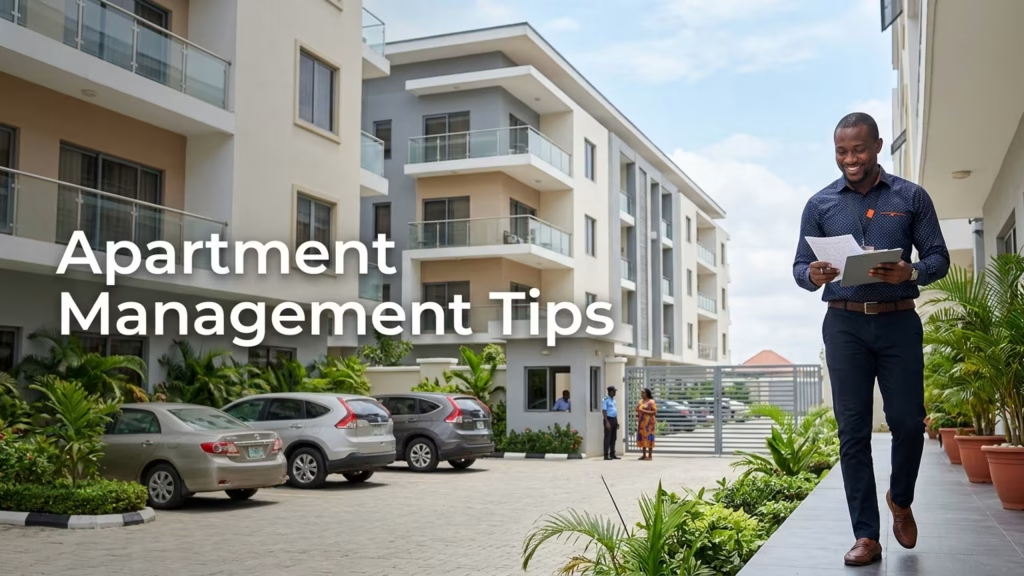
You need to keep the property occupied, maintain it properly, communicate with tenants, and control your costs.
For example, chasing the highest rent may seem profitable. Yet, ignoring a leaking roof or broken plumbing can make your apartment harder to rent.
Good apartment management is therefore about more than collecting rent. It means keeping your property occupied, well-maintained, properly documented, and financially sustainable.
What Does Apartment Management Involve?
Apartment management means taking care of your property and tenancy from the day a tenant moves in until they leave.
It includes finding and checking tenants, collecting rent, handling repairs, managing utilities, and keeping records.
You may also need to handle inspections, security, service charges, tenant complaints, and disagreements.
How you manage the property depends on your situation.
Should You Manage the Apartment Yourself?
Managing the property yourself can work if you own one or two apartments nearby. It also helps if you have enough time and reliable workers.
A professional property manager may be better if you own several apartments. The same applies if you live in another city or outside Nigeria.
A manager can handle rent collection, repairs, inspections, and tenant issues on your behalf.
The right choice is the one that keeps your property properly managed without creating unnecessary costs.
1) Screen Tenants Before Handing Over the Apartment
Checking a tenant properly is one of your first protections as a landlord.
An empty apartment costs you rental income. However, a tenant who refuses to pay or damages the property can cost you much more.
Start by checking the following;
- The applicant’s identity,
- Source of income.
- Employment,
- Rental history,
- References,
- Emergency contact,
- And intended occupants.
Do not simply collect documents and assume everything is correct. Where possible, confirm the information provided.
For example, if an applicant gives you an employer’s details, verify that the person actually works there. You can also contact previous landlords where appropriate.
Use the same reasonable checks for every applicant. Avoid unfair or discriminatory screening practices.
A simple tenant-screening checklist can help you make consistent decisions.
Most importantly, do not accept someone simply because they are ready to pay immediately.
Note:The goal is to have the right tenant, which can protect your property and reduce future problems.
2) Put Every Tenancy Agreement in Writing
Once you choose a tenant, put the agreement in writing.
A written tenancy agreement makes it easier for both sides to understand their responsibilities.
Your agreement should cover;
- Rent,
- Tenancy period,
- Renewal,
- Payment dates,
- Permitted use,
- Occupants,
- Repairs,
- Utilities,
- Service charges,
- Subletting,
- Alterations,
- Notices,
- Ending the tenancy.
However, avoid copying a random tenancy agreement from the internet.
Tenancy laws differ across Nigerian states. The rules that apply to a property in Lagos may not be the same elsewhere.
It is therefore wise to have a qualified property lawyer review the agreement. A clear agreement can prevent confusion and reduce disputes later.
3) Make Rent Collection Simple and Traceable
Rent collection becomes easier when you create a clear system.
Set payment dates from the beginning. Encourage traceable payments through bank transfers and issue receipts.
Keep proper records of every payment. You can also send renewal reminders 60–90 days before the tenancy expires. If a tenant stops paying, avoid taking matters into your own hands.
Do not lock the tenant out, remove their belongings, or cut essential services as punishment.
Instead, follow the legal process that applies in your state. This matters because rent and eviction rules differ across Nigeria.
A proper rent-collection system therefore protects your income and helps you handle disputes properly.
4) Maintain the Apartment Before Problems Become Expensive
Regular maintenance can help you find small problems before they become expensive.
For example, a small water leak may seem harmless. If you ignore it, however, it could damage walls, ceilings, floors, or another apartment.
Create a maintenance schedule that includes;
- Plumbing,
- Electrical systems,
- Roofing,
- Water tanks,
- Pumps,
- Generators,
- Solar systems,
- Air conditioners,
- Drainage,
- Doors,
- Locks,
- And common areas.
Keep records of repairs and servicing. This helps you know what has been fixed and what needs attention.
It also helps to separate routine maintenance from major repairs.
Routine maintenance includes fixing small leaks or servicing a water pump. Major repairs may include replacing a roof, upgrading electrical systems, or replacing major plumbing.
Set aside part of your rental income for future repairs. The amount will depend on the property’s age, condition, and equipment.
The important thing is to avoid spending every naira of your rental income.
5) Manage Utilities and Service Charges Clearly
Utility costs can quickly create arguments between landlords and tenants.
Before the tenant moves in, make it clear who pays for
- Electricity,
- Water,
- Waste disposal,
- Security,
- Cleaning,
- Alternative power,
- And common-area lighting.
If your building has several apartments, explain service charges clearly.
Prepare a simple budget showing what the money covers. Keep receipts and payment records for major expenses.
When tenants ask how their service charges were used, you should be able to explain the costs.
Clear records can build trust and reduce unnecessary disputes.
6) Inspect the Property Without Harassing Tenants
Regular inspections help you find problems before they become serious.
You may discover water leaks, damaged fittings, unauthorised changes, overcrowding, or security problems during an inspection.
However, being the landlord does not mean you can enter a tenant’s home whenever you want.
Respect the tenant’s privacy and follow the tenancy agreement and applicable law.
Arrange inspections with reasonable notice. Use a simple checklist to record what you find.
Where appropriate, take photographs of the property’s condition.
Ideally, record the condition at move-in, during inspections, and at move-out. These records can also help you identify damage beyond normal use.
7) Keep the Apartment Secure
Security should be part of your regular property checks. Inspect the gates, locks, fencing, lighting, access points, and other security features.
Depending on the property, you may also consider CCTV, controlled access, or security personnel.
For apartments inside an estate, clarify who handles security.
Some responsibilities may belong to the landlord, while others may belong to estate management or tenants.
Do not describe any location as completely safe.
Instead, look at the property’s actual risks and deal with problems you can identify.
Good security can also make your apartment more attractive to tenants.
8) Reduce Vacancy and Attract Better Tenants
An empty apartment does not generate rent. Therefore, reducing vacancy should be part of your apartment management plan.
Keep the property clean, functional, and ready for inspection. Price it based on similar properties in the same area.
Good photographs can also help attract serious enquiries. Your advert should accurately describe
- The property’s location,
- Size,
- Facilities,
- Rent,
- And other important details.
Respond quickly when potential tenants contact you. Before viewings, fix obvious problems that could discourage serious applicants.
However, do not accept the first applicant simply because you want the apartment occupied.
A poorly screened tenant can cause rent arrears, damage, or disputes. Focus on quality occupancy rather than occupancy at any price.
9) Keep Proper Property Records
Good records make property management easier.
So keep one central file for each property. Your records should include:
- Title documents,
- Survey plans,
- Approvals,
- Tenancy agreements,
- Tenant records,
- Rent receipts,
- Maintenance bills,
- Service-charge records,
- Utility bills,
- Inspection reports,
- Correspondence,
- And insurance documents.
If you manage several apartments, consider using a digital property-management system.
A simple system can help you track rent payments, maintenance requests, vacancies, and important dates.
You should also keep copies of important documents in a secure backup.
That becomes especially useful if you manage your property from another city or country.
10) Know Your Legal Responsibilities as a Nigerian Landlord
Managing property also means understanding the laws that apply to your apartment.
These laws may cover tenancy agreements, rent collection, notices, eviction, repairs, tenant rights, privacy, building approvals, and taxes.
Do not assume that one rule applies throughout Nigeria.
Tenancy laws differ between states. Lagos, for example, has its own tenancy legislation.
Therefore, check the rules that apply where your property is located.
If you plan to evict a tenant or take serious legal action, speak with a qualified property lawyer first.
This can help you avoid costly mistakes.
Legal advice becomes even more important when you manage property from abroad.
11) Use a Property Manager
Managing an apartment takes time. A professional property manager can handle;
- Tenant screening,
- Rent collection,
- Inspections,
- Repairs,
- Contractors
- Records,
- Tenant communication,
- And vacancy marketing.
However, hiring a property manager is not always necessary.
If you own one apartment nearby and have enough time, you may prefer to manage it yourself.
Professional management becomes more useful when you live abroad, manage several properties, or live far from the property.
Before hiring someone, compare their fee with the problems they could help you avoid.
Consider your time, unpaid rent, vacancies, repairs, tenant complaints, and contractor management.
The cheapest option is not always the one that costs you the least.
Common Apartment Management Mistakes to Avoid
Some landlord mistakes are easy to prevent.
Avoid:
- Accepting tenants without proper checks.
- Relying on verbal agreements.
- Ignoring small repairs.
- Mixing personal and property money.
- Losing important documents.
- Changing rent without checking applicable laws.
- Using unlawful eviction methods.
- Ignoring service-charge disputes.
- Choosing contractors only because they charge less.
- Failing to inspect the property.
Also, avoid managing everything from memory.
Tip: Good records and simple systems can save you from preventable problems.
A Simple Apartment Management System
You do not need a complicated system to manage your apartment properly.
Before Move-In
- Verify the tenant.
- Sign the tenancy agreement.
- Record the property’s condition.
- Collect agreed payments.
- Document the handover.
Every Month
- Track rent payments.
- Monitor utilities.
- Record repairs.
- Respond to tenant complaints.
Every Quarter
- Review maintenance needs.
- Check common areas.
- Review unpaid bills.
- Inspect the property where appropriate.
Before Renewal
- Review the tenant’s payment history.
- Check the property’s condition.
- Review applicable rent rules.
- Decide on renewal terms.
Following a simple routine helps you deal with problems before they become urgent.
Apartment Management Tips for Landlords Living Abroad
Managing Nigerian property from abroad requires stronger oversight.
You cannot personally inspect the apartment every time something goes wrong. You therefore need reliable people and clear systems on the ground.
Consider working with an independent property manager and a local property lawyer.
Arrange regular physical inspections and request digital reports after each visit.
Keep electronic records of rent, expenses, repairs, and tenant communications. Use secure payment channels and consider a properly prepared deed of assignment and power of attorney when someone needs to act for you.
You should also review financial reports, major expenses, maintenance work, and insurance regularly.
Most importantly, do not give one relative, agent, caretaker, or tenant complete control.
Independent oversight gives you a better view of what is happening with your property.
How Much Do Property Managers Charge in Nigeria?
There is no fixed cost of managing all the properties in Nigeria.
For the long-term rental properties, the present market sources usually estimate a percentage of 5%-10% on the annual or collected rent. In some cases, there might be a higher charge in case the provider provides more services and takes up challenging projects.
In addition to that, the Nigerian Institution of Estate Surveyors and Valuers has also suggested 10% of gross rent through the professional pricing scheme of the property management.
Your final quotation may vary based on several factors.
| Service | Common charging method | What affects the price? |
| Full property management | Percentage of rent | Property and services |
| Rent collection | Percentage or fixed fee | Rent value and workload |
| Tenant placement | One-off fee or commission | Property and market |
| Short-let management | Percentage of revenue | Occupancy and service level |
| Maintenance coordination | Actual cost plus possible fee | Repair type |
| Inspection | Fixed fee or included | Location and frequency |
| Vacancy marketing | Fixed fee or included | Advertising scope |
| Financial reporting | Included or separate | Management package |
In such cases, a 5% commission on an apartment that earns ₦3 million yearly amounts to ₦150,000.
If the commission is 10%, it will be ₦300,000; if 15%, it will be ₦450,000.
Nevertheless, these computations will not help you identify which one is more cost-effective.
Therefore, it would be important for you to find out the following:
“What is covered by this percentage
What Does a 10% Property Management Fee Actually Mean?
Let’s say your property generates ₦3 million in rent every year.
Assuming your manager takes 10% of the collected rent, then the math is:
₦3,000,000 x 10% = ₦300,000
This means you will pay ₦300,000 if you collect the whole ₦3 million.
However, 10% of collected rent is not the same as 10% of the expected rent.
Should your property be unoccupied, there is no need to pay a percentage-based fee in this period of time.
This is also the case if your tenant does not pay his/her rent entirely.
VAT, repairs, advertising, inspection fees, legal fees, and contractor fees among others should also be explained in your agreement.
Hence, always know that a 10% management fee is not necessarily your total property management fee.
What Services Are Usually Included in the Fee?
A comprehensive management service package could cover several aspects of the property’s day-to-day running.
Tenant Management
Your property manager could manage tenant screening, communication, complaints, renewals, move-ins, and move-outs.
This is especially helpful if you do not reside in the locality of the property.
Rent Management
The management service may cover reminders, collection, receipts, arrears management, and payment report.
Inquire about how the manager manages non-paying tenants.
The manager may just remind the tenant or take further actions on the arrears if required.
Property Management
This may include property inspection, coordination of maintenance, supervision of contractors, and common area management.
Inquire if the manager only reports a problem or supervises the maintenance.
Financial Reporting
The manager may issue income statement, expense report, maintenance report, and occupancy report.
The financial reporting becomes very important when you do not reside in Nigeria.
Before engaging, ask for the comprehensive list of services offered and inquire about those services that incur extra charges.
iPropty Insight
Managing an apartment successfully is about more than collecting rent.
You are protecting an asset while maintaining a good tenant relationship and controlling costs.
Start by screening tenants, documenting agreements, tracking income, and maintaining the property.
Keep proper records and understand the tenancy laws that apply to your location.
When the workload becomes difficult, professional property management can help.
Whether you manage one apartment in Lagos or several properties from abroad, the goal remains simple.
Keep your property occupied, maintained, documented, and financially sustainable.
A well-managed apartment should support your investment goals without becoming a constant source of stress or avoidable problems.

Author: Mary Itunnu
I specialize in real estate content, from captivating property descriptions and listing copy to insightful market articles that helps developers, agents, and brands transform property features into persuasive narratives that engage audiences and drive conversions.
Still have questions?
Navigating the real estate market can be complex. Head over to the iPropty Q&A hub to get expert answers, or ask your own question today!
Explore the Q&A Hub